.svg)


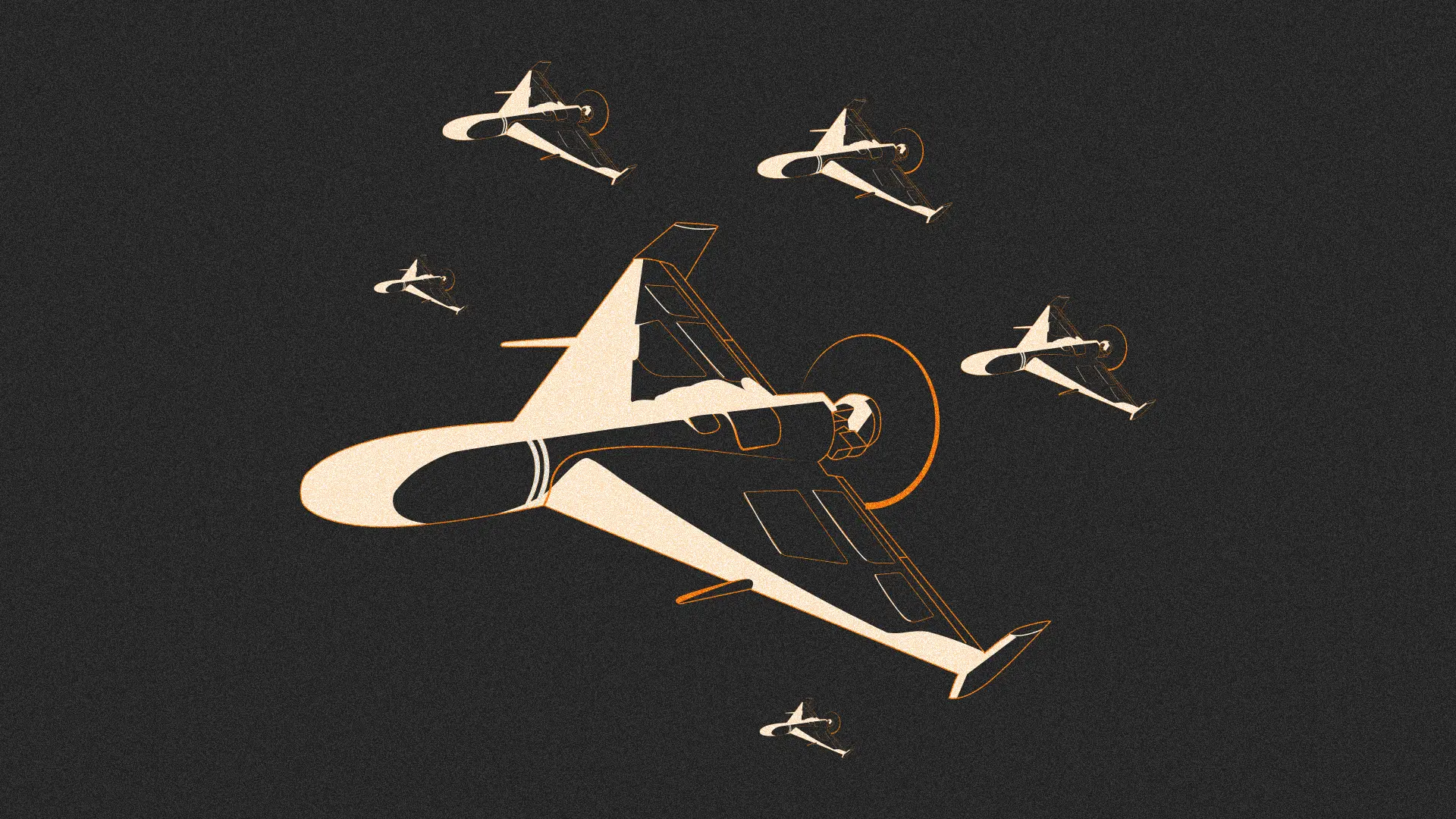


The $20,000 weapon that Iran built out of plywood, foam, and a lawnmower engine, and rewrote the rules of war with... Shahed 136.
A drone that does not look like a weapon, which worries anyone. It is roughly the size of a dining table. It is built, in significant part, from the same aluminium sheeting and composite foam you might find in a furniture factory. Its engine is a four-cylinder, two-stroke piston unit producing about 50 horsepower, sounds, famously, like a moped puttering through a quiet neighbourhood at 2 a.m. [3]
And yet this buzzing, low-tech object has done something that decades of sophisticated Western military engineering had not managed to accomplish: it has broken the economic logic of air defence. It has forced the world's most expensive military, the United States, to copy it. It turned Iran, a country under crippling international sanctions that can't legally import commercial aircraft parts, into one of the most consequential arms exporters of the twenty-first century.
A Factory Built for Bell Helicopters
To understand what the Shahed is, you have to understand where it came from. The Iran Aircraft Manufacturing Industrial Company, universally known as HESA, was established in 1976 in Shahin Shahr, on the outskirts of Isfahan. Its original factory was built by Textron, the American industrial conglomerate, to manufacture Bell 214 helicopters for the Shah's imperial air force. [4]
Two years later, the Shah was gone, Textron’s representatives were on the first flights out of Tehran, and the revolutionary government inherited a world-class aerospace facility with no one to run it. HESA pivoted, slowly, then with increasing ambition, toward domestic development, producing trainer aircraft, transport planes, and, eventually, unmanned systems. [4]
Then came 2011. An American RQ-170 Sentinel, a classified stealth reconnaissance drone operated by the CIA, strayed into Iranian airspace. [3] Iranian electronic warfare operators claimed to have spoofed its GPS signal, guiding it to a controlled landing on an Iranian airfield. [3] The outcome is not in dispute: the most technologically advanced stealthy surveillance drone in the US inventory was sitting intact in an Iranian hangar, and Tehran displayed it on state television. [3]
Iran reverse-engineered what it could. The resulting derivative systems, the Shahed-171 Simorgh and Shahed-191 Saeqeh, were direct products of that effort. [4] But the episode served a deeper purpose: it sharpened a design philosophy that would prove far more consequential. If you cannot build expensive and sophisticated, build cheap and numerous.
The Architecture of Simplicity
The Shahed-136 was publicly unveiled in 2021, though development had proceeded for several years prior. [3] Its design is a study in deliberate minimalism.
The airframe follows a cropped delta-wing configuration, a wide, triangular wing without conventional tail fins, with small rudders mounted at the wingtips for directional control. The body is a slender central fuselage carrying guidance electronics, fuel, and a warhead. [4] Total length is approximately 3.5 metres; wingspan 2.5 metres; maximum takeoff weight around 200 kilograms. [3] The outer skin is foam and fibreglass. [1]
Propulsion comes from the Mado MD-550 engine, a four-cylinder, two-stroke piston unit producing approximately 50 horsepower. [1] It drives a pusher propeller mounted at the rear of the fuselage, which is why the drone's exhaust note carries forward so distinctly, preceding the airframe across the sky. [3]
That engine is itself a point of controversy. Ukraine's Defence Express analysed the MD-550 in April 2023 and identified it as a near-copy of the German-made Limbach Flugmotoren L-550 aircraft engine. The open-market price for an L-550 runs between $12,000 and $17,000. A Chinese manufacturer was, as of early 2024, advertising the MD-550 for $13,580 per unit. [1] This single component cost matters enormously when evaluating what the Shahed actually costs to build, and the answer is considerably more than early reporting suggested.
What Does It Actually Cost?
For much of 2022 and 2023, media outlets, including the New York Times and CNN, reported that the drones were costing Russia approximately $20,000 per unit. [1] That figure is almost certainly wrong.
In February 2024, a hacking group calling itself Prana Network published what it claimed were documents from Sahara Thunder, an IRGC front company involved in the Shahed programme. The leaked material, reported by The War Zone and the Ukrainian outlet Militarnyi, contained the actual negotiated prices. The Iranians initially requested $375,000 per drone. That figure was eventually negotiated down to $193,000 per unit for a batch of 6,000, or $290,000 per unit for a smaller batch of 2,000. The total value of the initial production contract, encompassing technology transfer, manufacturing equipment, 6,000 UAVs, and software, was $1.75 billion. [2] Russia transferred over two million grams of gold to Iran as payment. [1]
The per-unit all-in price of $193,000 reflects total programme cost amortised across the production run, technology licence, factory setup, tooling investment, and Iranian profit margin. The production cost alone, what it costs Alabuga to manufacture each drone once the factory is running, was projected in those same leaked documents to fall to approximately $48,800 per unit as domestic Russian production scaled. [1]
Francisco Serra-Martins, CEO of Terminal Autonomy, maker of Ukraine's AQ-400 Scythe drone and a man who has personally dismantled captured Shahed systems for competitive analysis, told The War Zone directly: "The previously speculated figure of $20,000 per Shahed was significantly off the mark. It is uncommon for 50hp engines, a key component of the system, to be procured for under $10,000 unless through illicit channels." [1]
The honest answer is that the Shahed-136 costs somewhere between $35,000 and $80,000 to manufacture at Alabuga's current industrial scale, a price that continues to fall as production volumes increase and as Russian engineers progressively substitute imported components with domestically produced equivalents. [1] But even at $80,000, the cost-exchange logic of the weapon remains devastating.
The Guts of the Machine: What Is Inside a Shahed
Recovered wreckage analysed by The Guardian in September 2023 identified 52 Western-manufactured electrical components inside a Shahed-131, and 57 inside a Shahed-136. The navigation and anti-jamming modules carry the bulk of these imports: GPS and GLONASS receivers from Western and Japanese manufacturers, microcontrollers from Texas Instruments, and navigation antennas from Tallysman Wireless of Canada. The Shahed-238 jet-powered variant has yielded recovered fragments containing Intel-manufactured chips. [1]
This supply chain runs through Chinese and Hong Kong intermediaries. [1] As the Institute for Science and International Security (ISIS) noted in its September 2024 production analysis, foreign procurement from China, combined with the outsourcing of component production to other Russian enterprises, including warheads and anti-jamming units, likely played a critical role in enabling Alabuga to ramp up production at the pace it achieved. [2]
Russia has been working to close this dependence. Ukrainian analysis of Geran-2 variants recovered in 2024 found that imported controllers had been replaced with locally developed onboard computers and modules using GLONASS. Russia also installed domestically made "Comet" control-reception antennas. The fuselage material on newer variants was switched from carbon fibre to fibreglass, cheaper and easier to source domestically. Some recovered drones in 2024 were found to contain night-vision cameras and dual LTE modems, enabling real-time video transmission and in-flight course correction. These variants are no longer simply one-way kamikaze weapons; they can perform reconnaissance and target-adjustment missions simultaneously! [3]
From Isfahan to Alabuga: The Industrial Transfer
Russia's acquisition of the Shahed programme began with the first shipments of Iranian drones in the autumn of 2022. Reuters reported that Iranian representatives visited Moscow on 6 October 2022, where supply terms and a partnership on the drones were agreed. [3] The initial consignment was supplied directly by Iran, approximately 1,100 drones launched before domestic Russian production came online. Iran also provided Alabuga with 600 disassembled units as a starter kit for the manufacturing facility. [2]
JSC Alabuga contracted with Iran in early 2023 in a $1.75 billion franchise deal to supply 6,000 drones to the Russian Army by September 2025. [2] The Alabuga Special Economic Zone is located in the Republic of Tatarstan, approximately 500 miles east of Moscow, chosen both for its geographic depth from Ukrainian strike range and for the industrial infrastructure of a Soviet-era manufacturing hub. [1]
What happened next proved every sceptic wrong.
The ISIS analysis, authored by David Albright, Dr. Igor Anokhin, and Spencer Faragasso and published in September 2024, tracked Alabuga's production against its contractual commitments using Ukrainian Air Force daily launch tallies. In the nine months from April through December 2023, Alabuga manufactured at least the airframes for 2,300 Shahed-136 drones, an average of 256 per month. This significantly exceeded the contracted monthly target of 148. By 2024, the average monthly production reached 444 drones, almost double the contracted rate of 226 per month. Alabuga fulfilled its 6,000-drone commitment not by September 2025 as originally planned, but by the end of August 2024, a full year early. [2]
The contract contains a Russian balloon payment of $500 million to Iran once Alabuga produces 6,000 Shahed-136 drones. It remains unclear whether Russia's accelerated production required that payment to be made earlier than scheduled. [2]
The production numbers, sourced from Ukrainian Air Force tallies and compiled by ISIS, tell the story of a programme in exponential ascent:
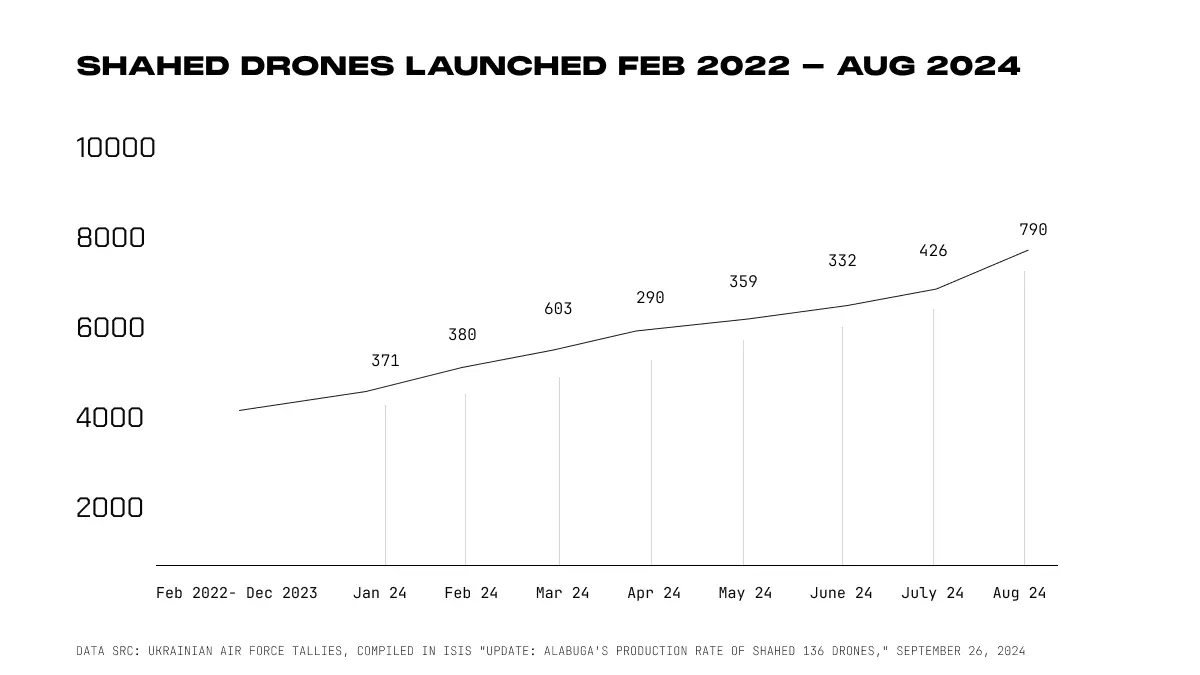
The average number of Shaheds per individual attack also rose sharply: from 14 drones per strike between April and September 2023, to 21 drones per strike from September 2023 through August 2024. [2]
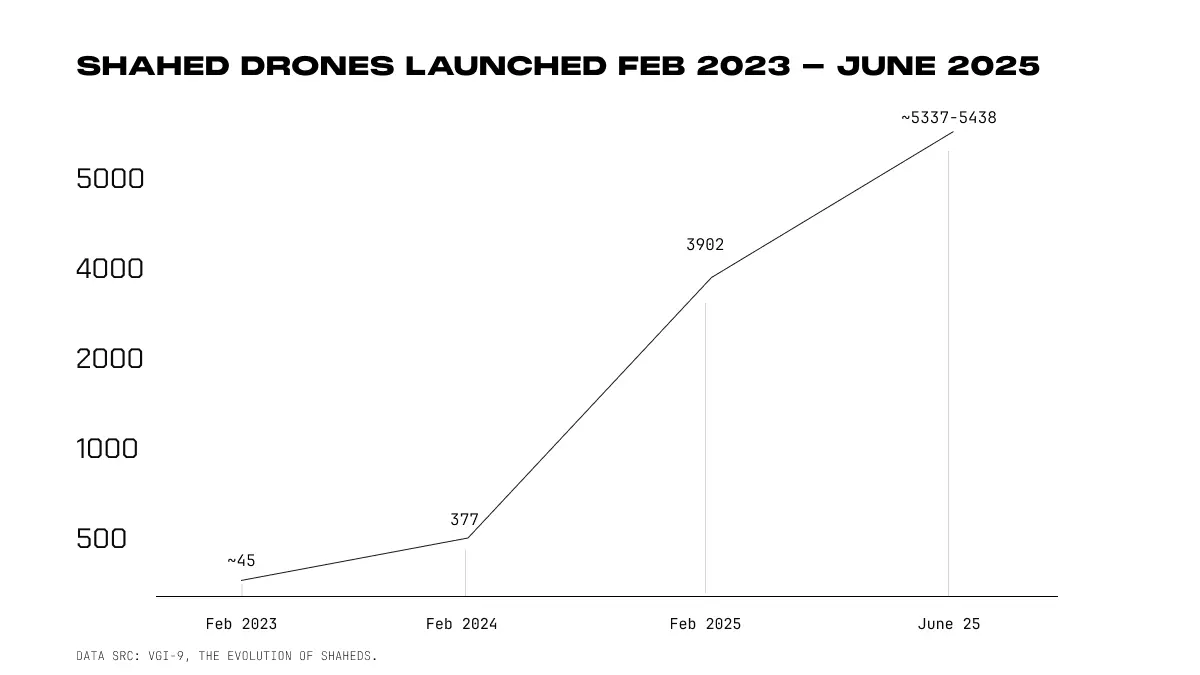
By early 2025, the scale had grown still further. According to VGI-9's analysis published in October 2025, Russia was producing approximately 2,700 Shaheds per month alongside approximately 2,500 Gerbera decoy drones. Ukrainian intelligence confirmed daily production at approximately 170 drones in May 2025, with plans to raise output to 190 per day by year's end. This is five times the monthly production rate of summer 2024. [3]
The Gerbera: The Drone That Carries Nothing
One of the most revealing developments in the Shahed programme is a weapon that does not kill anything. The Gerbera decoy drone, introduced in summer 2024, is an airframe built from plywood and foam, designed to be visually and radar-signature-identical to the Shahed-136. It carries no warhead and minimal electronics. Its sole purpose is to force Ukrainian air defences to engage it, consuming expensive interceptors against a target that costs a few hundred dollars to build. [2]
ISIS confirmed that JSC Alabuga was manufacturing Gerbera drones at its drone production facilities as of mid-2024, with production reportedly starting in May or June 2024. The facility was assessed as capable of making hundreds of Gerbera drones per month. [2] By 2025, approximately 2,500 decoy drones were being produced monthly alongside 2,700 armed Shaheds. [3]
The implication is significant. When Russia launches a barrage of 800 Shaheds in a single night, a substantial fraction of those 800 may carry no warhead at all. The number is classified. The defender cannot know which is which until it is too late to preserve the interceptor.
The Family
The Shahed-136 is the weapon the world knows, but it belongs to a broader family whose evolutionary arc reveals a programme in constant, iterative development.
Shahed-131 / Geran-1 is the smaller sibling: approximately 2.6 metres in length and 2.2-metre wingspan, powered by a Wankel rotary engine. Range is approximately 900 kilometres; warhead mass around 15 kilograms. Its visual distinguishing feature is its stabiliser fins, which extend both upward and downward, distinguishing it from the 136's upward-only configuration. [4] In Russian service, it is designated Geran-1 and deployed primarily against tactical targets, command posts, radar installations, and vehicle concentrations. [3]
Shahed-136 / Geran-2 is the primary strategic variant: 3.5 metres long, 2.5-metre wingspan, 200-kilogram takeoff weight, 50-kilogram warhead, 185 km/h cruise speed, range of approximately 1,700 to 2,500 kilometres. [3] The most produced, most launched, and most analysed member of the family.
Shahed-136B extends range to an estimated 3,000 to 4,000 kilometres by reducing warhead mass to carry additional fuel. [4] This variant places targets across the entire Middle East within striking distance from Iranian territory and was used in Iran's direct attack on Israel in April 2024.
Shahed-238 is a categorically different proposition: jet-powered, using what recovered fragments suggest is a variant of the Czech PBS TJ150 turbojet. [1] It achieves speeds of up to 500 to 600 kilometres per hour with impact velocities exceeding 700 kilometres per hour. At those speeds, it exits the engagement envelope of several short-range air defence systems calibrated around the slower Shahed-136's flight profile. Its confirmed appearance in the Russian inventory was established through wreckage analysis in March and April 2025. [3]
Warhead evolution has been continuous. By November 2024, Russia had used thermobaric warheads in Shahed variants. From late April 2024, variants carrying 90-kilogram warheads, almost double the original 50-kilogram, were confirmed in recovered wreckage. [2] These heavier warheads are loaded with high-velocity tungsten ball bearings, substantially increasing fragmentation damage. [3]
The AI Geran / MS-Series represents the most significant threshold crossing. In June 2025, Ukrainian military intelligence confirmed the recovery of a Geran-2 variant containing an infrared camera and an Nvidia Jetson AI module, a commercial machine learning processor capable of onboard image recognition. The same analysis confirmed the use of thermal imaging channels enabling GPS-independent navigation and the ability to lock onto heat-emitting targets autonomously. The first confirmed use of a Shahed with a night-vision camera was recorded during an attack on Nikopol in January 2024. [3] The original Shahed was pre-programmed and blind. The AI Geran sees, assesses, and selects.
The Numbers: 86 Percent Intercepted, 14 Percent Isn't
Ukraine has been shooting down Shahed drones at a rate that, by any conventional military logic, should have rendered the campaign futile. The ISIS analysis of Ukrainian Air Force data from April 2023 through August 2024 found an average interception rate of approximately 86 percent. In the best single month, May 2024, Ukraine intercepted 97 percent of incoming Shaheds. Even in the worst month, February 2024, the rate held at 77 percent. [2]
Russia launches 100 Shaheds to land 14.
That sentence appears to describe a failing weapon system. It is not. Across the entire assessed period, April 2023 through August 2024, 86 percent interception still meant at least 878 Shaheds reaching their targets. ISIS concluded that Russia may view its barrage strategy as effective despite the high interception rate, knowing that the fraction which penetrates causes immense damage. [2]
The interception rate dipped from August 2023 through February 2024, likely reflecting production surges outpacing Ukrainian air defence capacity at that moment. The recovery from March 2024 onward may reflect additional Western air defence supplies arriving and Ukraine's improving institutional knowledge of Shahed intercept techniques. [2]
The escalation in attack scale made these averages increasingly abstract. By February 2025, Russia was launching approximately 3,902 Shaheds that month, an average of 120 to 140 per day. On 21 March 2025, 214 drones were launched in a single event. On 7 May 2025, 218. On 17 June 2025, 440. On the night of 7 September 2025, over 800 Shaheds and dozens of missiles struck Ukraine simultaneously, the largest single drone assault of the entire war. Ukraine's Commander-in-Chief Oleksandr Syrskyi later cited an example: of 502 drones launched in a single night, Ukrainian forces shot down 430, including through the use of interceptor drones. [3]
The monthly trajectory is unambiguous:
The Sanctions Paradox
The Shahed's component manifest tells a story that Western governments have chosen not to tell loudly.
Fifty-two Western-manufactured electrical components were recovered inside a Shahed-131; 57 inside a Shahed-136. GPS receivers, navigation antennas, microcontrollers, and engine technology all routed through shell companies and Chinese intermediaries. The Shahed-238's engine components have yielded Intel chips in recovered wreckage. Texas Instruments microcontrollers. Tallysman Wireless antennas from Canada. [1] All inside a weapons system produced by a state under comprehensive multilateral sanctions.
The ISIS September 2024 report stated the operational implication plainly: because shooting down all the Shahed drones has proven impossible, and jamming them has also proven difficult, stopping the supply of foreign components, particularly microelectronics, must be a higher priority, and Western semiconductor companies need to do considerably more to prevent their products ending up in Russian weapon systems. [2]
Seeking foreign components through shell companies and intermediary layers drives up costs, but it has not stopped production. [1] Russia's accelerated production, exceeding every contracted milestone, demonstrates that the sanctions architecture has created friction without prevention.
The Wall Street Journal reported that Russia had been recruiting women from Uganda, Nigeria, South Africa, Cameroon, and other African nations to the Alabuga facility under promises of hospitality industry employment. On arrival they found drone assembly work. South Africa opened a formal investigation. The supply chain of the drone that remade modern warfare runs, in part, through human trafficking.
What $80,000 Buys
The cost-benefit arithmetic of the Shahed deserves to be stated without evasion, because it is the central fact of modern air defence.
A Patriot PAC-2 interceptor costs approximately $4 million. A Patriot PAC-3 costs between $4 million and $6 million. An AIM-120 AMRAAM, the standard Western air-to-air missile adapted for drone intercept, deployed on Ukraine's NASAMS systems, costs between $500,000 and $1 million per round, depending on variant. A Shahed-136, at Alabuga production cost, runs $35,000 to $80,000. [1]
The cost ratio at worst, a Patriot PAC-3 against a Shahed, is 75:1 in the attacker's favour. The War Zone noted that for Russia, even at $50,000 or more per unit, the Shahed is far less expensive than the air defence munitions used to counter it, and at the volumes Russia is now launching, it costs Ukraine and its NATO suppliers a great deal more than the drones themselves cost to produce. [1]
Russia needs to launch 100 Shaheds for 14 to reach their targets. [2] At $35,000 to $80,000 per drone, 100 Shaheds cost between $3.5 million and $8 million. Those 14 that penetrate can destroy transformer stations worth tens of millions, power plants worth hundreds of millions, logistics nodes essential to an entire front. The maths has never favoured the defender.
140 a Night: The Campaign Against Ukraine's Grid
Russia first deployed Shaheds at scale against Ukraine on the night of 13 September 2022. The targets were not military positions. They were energy infrastructure, transformer stations, heating plants, and the interconnected grid that keeps cities habitable through winter. One of the most consequential early attacks occurred on 10 October 2022, when Russia combined hundreds of missiles and dozens of Shaheds in a coordinated strike, leaving large parts of Ukraine in prolonged blackout. [3]
The campaign that followed was one of systematic, sustained attrition. Russia combined Shahed swarms with conventional cruise missile salvoes, Shaheds flying from one direction to saturate radar and exhaust interceptors, Kalibr or Kh-101 missiles arriving from another. [3] The Shaheds were partly decoys, partly weapons. An air defence system must engage everything.
By February 2025, the average daily launch rate had reached 120 to 140 Shaheds. The monthly total for February 2025 alone was 3,902 drones. In the first five months of 2025, Russia launched roughly 13,000 Shaheds and their decoys. According to President Zelensky's address to the Dutch Parliament on 24 June 2025, since the start of Russia's full-scale invasion, 28,743 Shaheds had been launched at Ukraine. [3]
The drone's low speed and simple GPS/INS navigation, vulnerabilities in daylight, become tactical assets at night. Its relatively large size and audible engine make it detectable, but at night, detection systems are less effective, and the use of swarms alongside decoys saturates the response capacity of any finite air defence network. [3]
Ukraine's countermeasures have evolved in parallel. The initial response deployed mobile units in off-road vehicles equipped with heavy machine guns, anti-aircraft mounts, MANPADS, thermal scopes, and searchlights. These became less effective as newer Shahed variants began flying above 4 kilometres, out of reach for mobile teams. Ukraine then built a multilayered system combining short-range air defence, NASAMS, IRIS-T, and Patriot systems for critical infrastructure, electronic warfare stations to jam navigation signals, and, from mid-2025, purpose-built interceptor drones. By July 2025, interceptor drones accounted for nine out of every ten Shaheds shot down. The "Clear Sky" project protecting Kyiv Oblast alone had intercepted approximately 550 Shaheds through its drone-versus-drone approach. [3]
The Copy
In July 2025, US Secretary of Defence Pete Hegseth stood in the Pentagon courtyard and held up a drone called LUCAS, Low-Cost Uncrewed Combat Attack System. SpektreWorks, the Arizona company that developed it, had begun with the FLM-136, a target drone designed to simulate the Shahed-136 for counter-drone training. "The U.S. military got hold of an Iranian Shahed. We took a look and reverse-engineered it," a US official told The War Zone in December 2025. The programme cost $35,000 per unit. The US deployed it to the Middle East in December 2025 under Task Force Scorpion Strike.
On 28 February 2026, CENTCOM announced that LUCAS drones had been used in combat for the first time during Operation Epic Fury, joint US-Israeli strikes against Iranian military infrastructure. The official announcement read: "These low-cost drones, modelled after Iran's Shahed drones, are now delivering American-made retribution."
The drone that a sanctioned, isolated Iranian engineering team built from stolen American technology and copied German engine blueprints had, in five years, compelled the world's most powerful military to reverse-engineer it and fly it back at Iran.
The Weapon and What It Means
Between September 2022 and the end of 2025, Russia launched 28,743 Shaheds at Ukraine, a figure cited directly by President Zelensky in his address to the Dutch Parliament on 24 June 2025. [3]
Power stations. Water treatment plants. Hospitals. Residential buildings.
On 7 September 2025, the largest single Shahed attack of the war struck Ukraine with over 800 drones simultaneously. Civilians were killed, and many more injured. [3] The attack underscored that three years into the campaign, neither the volume nor the intent had softened.
These were not military targets. Marcel Plichta, a fellow at the Centre for Global Law and Governance at St Andrews and a former US Department of Defence analyst, described the pattern: Shaheds have mostly been used for strategic, almost terror bombings behind the front lines, taking advantage of their long range to attack major cities.
The weapon that HESA engineers designed in a factory originally built by Textron to make civilian helicopters, assembled in part by trafficked workers in a Tatar industrial park, powered by a copied German engine, guided by Canadian navigation antennas and American chips, launched from Russian trucks, has killed civilians across three years and three winters.
It costs between $35,000 and $80,000 to build. [1]
It costs the world considerably more to stop.
References:
[1] Howard Altman, "What Does A Shahed-136 Really Cost?" The War Zone, February 8, 2024. https://www.twz.com/news-features/what-does-a-shahed-136-really-cost
[2] David Albright, Dr. Igor Anokhin, and Spencer Faragasso, "Update: Alabuga's Production Rate of Shahed 136 Drones," Institute for Science and International Security, September 26, 2024. https://isis-online.org/isis-reports/detail/alabugas-greatly-expanded-production-rate-of-shahed-136-drones
[3] VGI-9, "The Evolution of Shaheds: How Russia Scaled Its Drone Warfare," VGI-9 Blog, October 13, 2025. https://vgi.com.ua/en/the-evolution-of-shaheds-how-the-enemys-weapon-developed/
[4] Open Measures Project, "Shahed-131/136 UAVs: A Visual Guide — Origin & History," https://osmp.ngo/collection/shahed-131-136-uavs-a-visual-guide/